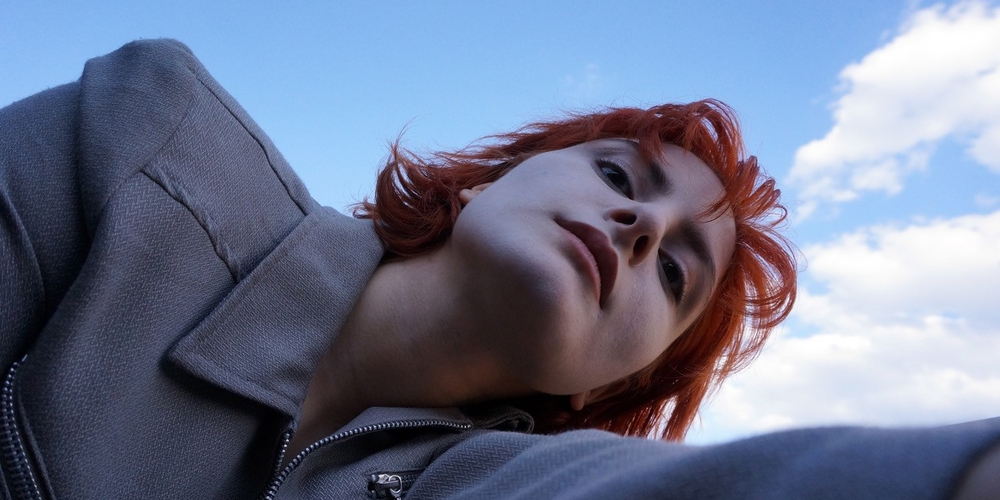
Rebellion seeps through the work of Beirut-born artist Thoom. With her label ‘Career Whore’ and a musical shift away from the usual harsh noise sounds, she continues to challenge the music industry. On ‘Pork’ she distances herself from her aggressive electronic noise and takes her first steps as a singer-songwriter.
It could have been a reference to the Arabic word for ‘garlic’. It isn’t. Thoom was a word that “I just kept hearing. Like a hallucination or something, driving at night. It felt spiritual. ‘Pork’, the title of her debut album, was also chosen for its sound. As a young rebel, however, she went completely against her Islamic upbringing by wanting to eat pork. ‘I find it really disgusting now.
Just as rebellious was the making of the video ‘No Speech’. Together with her sister, Thoom went to a number of specific areas in Beirut that are guarded by the military. Just to dance, in front of the soldiers, who no doubt wondered what she was doing. ‘The music industry is a game. I want to make fun of it. It doesn’t have to be so professional. Which is also why she called her record label Career Whore. As a kind of finger pointing at all the problems of doing PR and men always trying to bring her down. ‘It makes me feel like a career whore. Also, this feeling of men bringing her down is a feeling she experiences much more in Europe than in Lebanon. ‘I don’t know what it is. I’m never allowed to enter Berghain unless I’m playing.’ Meanwhile she’s trying to get a visa, in Germany. In Berlin. ‘My boyfriend already got his, while I have to constantly prove that I am an artist.
Berlin
Thoom is not just another artist trying to make a career playing industrial techno in a city that has become synonymous with the genre. ‘I had to get out of the United States. I wanted to be closer to Beirut. I never wanted to move to the States.’ So far, she doesn’t really like Berlin. ‘I can’t find a place for myself here. I don’t really like the music in Berlin either.’ It seems almost ironic that a musician who admits to being influenced by industrial music can’t connect with a city that breathes industrial techno. It soon becomes clear that she doesn’t want to be pinned down to a particular sound. As an artist, she wants to keep searching and changing. Even if it means, as she puts it, ‘alienating the experimental fan base’. ‘It had to happen. This is how I relate to music.
The production process of ‘Pork’ felt very cultish. Me, my boyfriend, his twin brother. For ‘Shaytan’ she got input from her mother. ‘I take her advice to heart. She never finished school, but I really wanted her perspective. I wanted to work with people who were close to me, and who’s closer to you than your own mother? I really valued her advice.’
Lebanon
This is the story of someone in exile. Someone looking for their place in the world to call home. It explains the loneliness you feel seeping into the conversation.
Her home country is Lebanon. Her city, Beirut. Her neighbourhood, Tarik el-Jdideh. An area that is not only known for being rather conservative and overcrowded, but one that seems to carry all the instability of the country. In Lebanon, you never know when something is going to happen. You only know that something could happen at any time. (This interview was conducted before the port explosion that rocked Beirut on 4 August, KS).
Thursday, 17 October 2019. In response to the Lebanese government’s announcement that it would begin taxing WhatsApp messages, the country erupts into massive protests. In every part of Lebanon, people take to the streets to protest against money-grabbing, corrupt politicians. A thawra (Arabic for protest, ks) that only stopped at the beginning of March because the country had to go into lockdown when it was hit by Covid-19. As soon as the restrictions were eased, people returned to the streets. In that short time, the Lebanese lira was massively devalued, people had lost their jobs and all their money was gone.
That night, the first night of the revolution, Thoom set off to play Ballroom Blitz, accompanied by Deena Abdelwahed. While they were performing, protesters began to block the streets. Car tyres are set alight everywhere, choking the city with a toxic black smoke. (The author of this article was also in Beirut that night. But not at the performance.) Cars are stopped. The road to the airport is blocked. The next day, Thoom was due to play a show in Italy. She leaves immediately after her set, afraid she might not make it to the airport. ‘I’ve never seen Deena’s set,’ she adds regretfully. The next day, the country is in chaos. A chaos that now, after the explosion in Beirut, seems desperate.
The best music comes from your subconscious. When you do things instinctively, without self-judgement or self-censorship.
Mid-West
From Beirut to Iowa. A past she doesn’t really talk about. Just that Iowa was boring. Her move to Chicago opened up possibilities. Even if she didn’t really find the city liberating. ‘The neighbourhood I lived in was a very tough place. It was an area where a lot of shootings happened. It became the new norm.’ But here in Chicago, she discovered music and began to wander around in what she calls the good underground scene.
Unlike other musicians, Thooms’ productions are not about ‘being beautiful’, but about ‘what sounds good’. While living in Chicago, she created a much more industrial and raw sound than what you hear on ‘Pork’. Drawn to industrial and noise, she created a musical record that gave her space to channel her anger, frustration, confusion and sadness. Lately she prefers to write songs like a singer-songwriter. ‘This album is meant to be listened to all the way through. It goes through a lot of different emotions, from anger and sadness to a dancy light feeling.’ At the moment she doesn’t just listen to Nirvana all day, she’s also started listening to Arabic and American folk music a lot more.
Your influences always seep through. Whichever they’ll be, they’ll show up at the most unexpected moments. Whether it is Genesis P.Orridge, Soapkills or Michael Jackson.
As a musician, she now wants to make music in a more traditional sense, with her voice taking the leading role. ‘What can my voice do? What sounds can I make? But I don’t hold back either. If I want to sing a certain sound, I just do it. Singing comes from the whole body. I don’t want the music that comes out now. We need the music we listened to as teenagers. Songs that show us universal things. Like Oum Kaltoum,… There is so much emotion in her singing. It is more accessible. In a human voice you can hear honesty, feelings. Even very minimal songs can bring me to tears.’
So how has the confinement and the sudden disappearance of a vibrant music scene affected her? ‘I have never been so isolated and lonely as I was during the confinement. It made me realise how important it is to be close to people. But as a musician you also want to isolate yourself. At the moment I have no one to judge what I do. It’s very much in my own head. But that’s where the best music comes from. When music is in touch with your subconscious. When you do things instinctively, without self-judgement or self-censorship.’